Keymod Or M Lok Slots
Conceptually, M-Lok, short for Modular Lock, is the same neighborhood as KeyMod – it’s a negative space mounting system that allows you to attach accessories to your firearm. Rather than the keyhole format, M-LOK uses a slot-like design which originated on the Masada Concept Rifle way back in 2007. Strike Industries Red Accessory Rail SI 6 Slot Link Fits BOTH Keymod & M-LOK. Your Price: $24.95 In Stock. M-Lok As an Alternative to the KeyMod Rail System. In 2014, Austin, TX-based Magpul Industries introduced a variation of the KeyMod system. Known as M-Lok, this rail system has been designed to work more effectively with polymer attachments. Instead of the KeyMod’s keyholes, the M-Lok system features a series of slots. The Patent Pending WedgeLok KeyMod covers securely wedge into KeyMod slots to provide a secure comfortable grip on handguards or other equipment with KeyMod attachment points. Molded with an aggressive texture, the WedgeLok covers are easily installed or removed without tools.
Remember Betamax? It was the early rival to the VHS videotape format, and at one time, just as popular. But if you were born after about 1980, there’s a good chance you’ve never even seen a Betamax tape.
We’re about to see a similar showdown play out in the world of rifle accessory rails. The picatinny accessory rail system has been the standard for bolting stuff to our AR-15s and other rifles for several years now. It’s an excellent system, especially for mounting optics, but including picatinny rails on a rifle’s foreend/handguard can add a lot of unwanted bulk and weight.
To alleviate this, there are low profile handguards that allow the user to attach small sections of rail only where they are needed. Not a bad solution, but what if we could eliminate the middle step and attach accessories directly to the handguard without the need for a picatinny adapter? The KeyMod and M-Lok systems do just that.
The KeyMod System

Released in 2012, KeyMod was developed and released through a partnership between VLTOR and Noveske. It’s an open-source, public domain design, meaning that any company can make rails or accessories using the system without paying a dime in royalties.
Handguards built with the Keymod system can be incredibly lightweight, and allow for the direct attachment of any Keymod-compatible accessories. Several companies already produce Keymod rifles and handguards as well as attachments like vertical foregrips, bipod adapters, sling adapters, and flashlight mounts.
Keymod rails consist of rows of “keyholes”. To attach a keymod-compatible accessory, line up the lugs on the accessory with the round part of the keyhole. Slide it forward, and then tighten the screws.
Demo: Attaching a bipod mount to a Bravo Company KMR-13 KeyMod rail
The Magpul M-Lok System
Pretty cool idea, right? Well, Magpul thought so, too. They looked into making some Keymod-compatible accessories, but weren’t happy with the way the system worked with polymer attachments. So earlier this year, Magpul came up with their own competing standard called the M-Lok system. To increase their chances of this new standard taking off, Magpul has also made M-Lok free for other companies to use.
Magpul’s new M-Lok system uses slots in place of the keyholes. The attachment lugs on M-Lok accessories are t-shaped and bi-directional so they can be placed at the front or rear of the slots.
Demo: Attaching a flashlight mount to a Midwest Industries M-Lok rail
So now we’ve got two open-source direct-attachment rail system standards that are a little different but ultimately seek to address the same problem. Will the marketplace tolerate two standards? Or will one eventually dominate, leaving the other to become the forgotten Betamax of the AR world?
| M-LOK | |
|---|---|
| Type | Attachment System |
| Place of origin | United States |
| Production history | |
| Designer | Magpul Industries |
| Designed | 2007–2014 |
| Produced | 2014–present |

M-LOK, standing for Modular Lock, is a free licensed[1]firearmrail interface system developed and patented by Magpul Industries.
M-LOK allows for direct accessory attachment onto the 'negative space' (hollow slot) mounting points, and is a competing standard to VLTOR's open sourcedKeyMod system for replacing the ubiquitous Picatinny rail in some applications.[2] Compared to the Picatinny rail system, both M-LOK and KeyMod enable the user to have a slimmer, lighter, smoother and more fenestratedhandguard/fore-end with accessories mounted only where needed, whereas a Picatinny handguards typically will have rail slots for its whole length resulting in a heavier and bulkier handguard with sharp edges and poorer barrel ventilation.
The M-LOK system can be seen as an evolution of the Magpul Original Equipment (MOE) system, but the two are not fully compatible. Though newer M-LOK accessories can be used on older MOE slot handguards if an adaptor plate is used, there is no adaptor available for using older MOE accessories on the newer M-LOK handguards.
History[edit]
A prototype of the MOE slot was revealed by Magpul in late 2007 together with their Masada Concept Rifle (which would later be known as the Adaptive Combat Rifle). The MOE slot system was released by Magpul in 2009 as a feature on their MOE handguards, and at the same time compatible accessories such as Picatinny rail sections, direct MOE mounted light mounts, grips, bipod studs, etc. were released.
The MOE slot standard was never officially released, and a drawback to the system was that the rear side of the panel had to be accessed in order to mount accessories, limiting its application. The MOE slot system uses a weld nut which has to be placed manually on the inside of the handguard before mounting, making the slot system unsuited for applications such as free-floating handguards. Also, depending on the accessory item, the spacing increments between the MOE slots were not small or uniform enough to adjust the desired placement of accessories.
Acknowledging shortcomings of the MOE systems, Magpul drafted M-LOK as a new and improved mounting standard which was released in 2014 replacing the existing MOE slot. The M-LOK rail specification included metric dimensions instead of imperial, and utilizes a T-slot nut capable of only 90-degree rotation, reinforced by thread-locking fluid, making it suited for applications on free-floating handguards. It was designed to work with both metal and polymer parts.
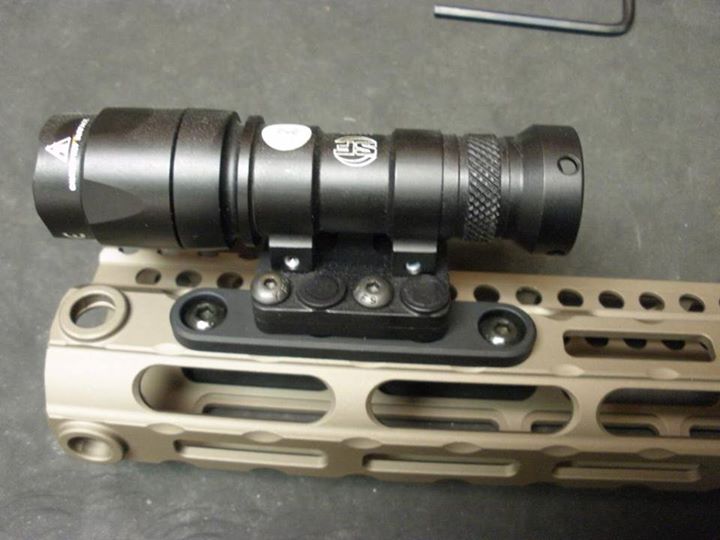
In 2016, Colt Canada developed and released the Modular Rail Rifle (MRR) that uses a monolithic upper receiver with the M-LOK attachment system.[3] In 2017, several companies produce M-LOK handguards as well as accessories like Picatinny rail strips, vertical foregrips, bipods, sling adaptors, and flashlight mounts.[4]
In 2017, a summary report of testing conducted by NSWC-Crane for USSOCOM indicated that, while comparable in endurance and rough handling testing, M-Lok greatly outperformed Keymod in repeatability, drop testing and failure load testing.[5]
Licensing[edit]
While M-LOK is free licensed, it is not open source, and thus manufacturers must acquire a license from Magpul before making products using the M-LOK standard. Magpul claims this gives them more control in assuring that all M-LOK products are made to specifications ensuring compatibility. Program participation is open to any interested manufacturer.
Technical specifications[edit]
Rail specifications[edit]
The slot dimensions (used on handguards, etc.) are available on the web.[6] The slots provide metric 20 mm (0.79 in) length intervals, and accessories can be mounted either within a slot or bridging between slots, making it possible to adjust the position of accessories in smaller intervals than the length of the slot. The slots on an M-Lok handguard are approximately 32 mm (1.260 in) long and 7 mm (0.276 in) wide and space 8 mm (0.315 in) from each other. The radius of the corners is approximately 2.38 mm (0.094 in).[7][8][9]
Attachment specifications[edit]
The quarter-turn T-slot nuts have different torque specifications depending on the handguard material:
- 4.0 N⋅m (35 lb⋅in) for attaching metal accessories to metal handguards.
- 1.7 N⋅m (15 lb⋅in) for attaching polymer or metal accessories to polymer handguards.
- 1.7 N⋅m (15 lb⋅in) for attaching polymer accessories to metal handguards.
Attachment screws made by many U.S. manufacturers are often either #8-32 TPI or 10-24 TPI UNC threads, which respectively have major thread diameters of 0.1640 inches and 0.1900 inches (4.166-0.794 mm and 4.826-1.058 mm expressed in metric designation). Many M-LOK screws on the international market instead use either M4 or M5 metric threads to reduce cost.
The tool required for mounting, in addition to the thread size, also depends the screw head type. Hex keys are used extensively in the firearms industry, but metric and imperial hex keys as a general rule are not compatible. It is possible damage the tool and screw by selecting a tool that is too small for the fastener, which can be done by using an Imperial/customary tool on a metric fastener, or the converse. An exception to this is 4 mm hex keys, which are almost the exact same size as 5⁄32 in (3.97 mm). In many industries, this makes 4.0 mm (5⁄32 in) hex keys preferred for consumer products because end users can successfully use an imperial key on a metric fastener, and vice versa.
| Hex key spanner (wrench) size | ||||
|---|---|---|---|---|
Thread type | Socket head cap screw | • Button head cap screw • Flat head counter- sunk cap screw | ||
| M4 | 3 mm | 2.5 mm | ||
| M5 | 4 mm | 3 mm | ||
| #8-32 TPI | 9/64' (3.57 mm) | 3/32' (2.38 mm) | ||
| #10-24 TPI | 5/32' (3.97 mm) | 1/8' (3.18 mm) | ||
While screw and slot dimensions are available on the web, the T-slot nut dimensions are currently under review by the US State Department to determine whether it should be regulated by ITAR, and until it is clarified drawings are only available to US citizens.
M-LOK handguard and attachment parts
M-LOK approximate slot dimensions. (Primary measurements in millimeters, inches in parenthesis).
See also[edit]
Keymod Or M Lok Slots No Deposit
- Rail Integration System, generic term for a system for attaching accessories to small firearms
- Weaver rail mount, early system used for scope mounts, still has some popularity in the civilian market
- Picatinny rail (MIL-STD-1913), improved and standardized version of the Weaver mount. Used for both for scope mounts, and for accessories (such as extra sling mounts, vertical grips, bipods etc.) Major popularity in the civilian market.
- NATO Accessory Rail- further development from the MIL-STD-1913
- UIT rail, an older standard used for mounting slings particularly on competition firearms
- KeyMod - competing standard open standard design to M-LOK for mounting accessories
- Zeiss rail, a ringless scope mounting standard
Keymod Or M Lok Slots
References[edit]
| Wikimedia Commons has media related to M-LOK. |
- ^'Magpul Industries - M-LOK'. Archived from the original on 4 December 2017. Retrieved 6 June 2016.
- ^KeyMod vs. M-Lok: The Next AR Rail Standard by Chris Baker, November, 19, 2014
- ^Colt Canada Modular Rail Rifle (MRR)
- ^M-LOK Outselling KeyMod about 3 to 1, 28 January 2016
- ^Details On The USSOCOM Sponsored KeyMod vs M-LOK Test Conducted at NSWC-Crane, 5 May 2017
- ^Magpul Industries - M-LOK DESCRIPTION AND FAQ DOCUMENT[permanent dead link]
- ^'magpul.com - M-LOK 2015 FAQs'(PDF). Archived from the original(PDF) on 7 April 2019. Retrieved 7 April 2019.
- ^M-Lok dimensions
- ^Magpul M-LOK estimated dimensions